Tuesday Double Feature: Delicacy and Ink Flow

Tuesday, April 29, 2008


Hi, and welcome back for another Tuesday double feature! This week we'll take a look at work from indie artists you can find on Etsy: Carol Bruno and the dynamic duo, Michael Ayers and Lani Mathis.
Carol Bruno is a New Jersey artist whose work came into focus after the loss of her only brother. Her watercolor depiction of hydrangeas has an undeniable fragility, and the delicate colors transport one to one of those rain washed days in late spring or early summer. This is a perfect piece for contemplative viewing.
The collaborative ink creations of Ayers and Mathis, lifelong creative people, bring a different sort of energy to the table. Their many inkblot collabs, such as Seamore (above) have a wonderful sense of play that will surely brighten your day.
Both Bruno and the Ayers-Mathis team created these pieces with surrealist techniques. Bruno used a crumpling method of composition reminiscent of frotage. Ayers and Mathis created their ink blot with a method similar to the 'exquisite corpse' method in which each participant takes turns adding elements to the composition. In both cases we see how fortuitous these 'accidental' methods can be.
Next week we'll look at another indie artist, Tiffany Teske.
To find out more about Ayers & Mathis, follow the link to their blog, Green Space goods, on the right. See more of Carol Bruno's work by following the link to her shop above.

Everything you wanted to know about Guernica but were afraid to ask in less than 5 paragraphs!

Tuesday, April 22, 2008


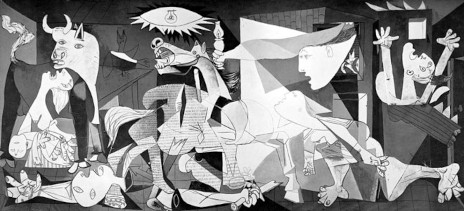
Picasso's Guernica is like the fabled 'great American novel', oft talked of but rarely seen. It is one of those pieces of art that is so important, everyone in-the-know automatically assumes you know all about it. I hate to break it to all those art historians and critics, but Dali is actually more popular ^^ So I am going to give you all the rundown on what this Guernica stuff is all about and why it's so important.
First of all, before Guernica was a painting, it was a town - a town in Spain where a terrible atrocity took place. During the Spanish Civil War, Spanish nationalists, lead by the famous Gen. Franco, arranged to allow German Nazis the chance to test their new bombs - on Spanish civilians. As many as 1500 people were killed and many more injured, and all of this many months before the official start of WWII.
Within weeks of this event, Picasso was already working on the huge 11'x23' canvas in black and white paint only....for war drained life and color from the world. The style was neither cubist nor surreal, but Picasso's personal style with cartoon-ish, primitive, stylized figures. The scene seem to take place in something like a cellar, a place where people are fleeing from the horrors of war, horrors seen in every twisted human figure in the painting. To me, one of the most telling bit of symbolism is the electric in the upper center left. The electric eye is a symbol of progress yet it's light is impotent and the scene must be lit by an old fashioned flame just to the right.
Even today the strong symbolism of Guernica is something feared by those who would engage in war. In 2003, a copy of Guernica hanging in the United Nations was covered up and hidden so that Gen. Colin Powell and John Negroponte could speak about why war with Iraq was necessary without any pesky reminders of the cost.
Well, I hope you enjoyed learning about Picasso's Guernica, and please let me know if you have any more questions about the piece. Next week will be another Double Feature.

Tuesday Double Feature! Mystery and Whimsy

Monday, April 14, 2008


Madelaine and Lance Perry bring a lot of creativity to the table when they get to work. (Above left 'how i got my stutter' Madelaine; above right 'Ladybug with a Flower' Lance Perry.) Madelaine brings us the insecurities and dilemmas of growing up while Perry takes us back to the childhood we never knew.

Madelaine, a Canadian born artist living in West Virginia, is a precocious 17 already in college and supporting herself through her art (you go, girl!) 'How i got my stutter' is a piece of digital art laden with imagery culled from childhood vulnerability, tea lore, and criminal psychology.

Using her own features, Madelaine created a waif of a girl, thin beyond belief. Holding a butterfly suspended like a tea bag, we are reminded of some of the more dreadful childhood passtimes: pulling the wings off flies, burning ants with magnifying glasses. The way the young woman holds the butterfly, however, tells us that the movement has been arrested. Whatever personal pain might have prompted her to think of making butterfly tea, that pause shows that she can regain her purity, if not innocence, but we are not allowed to see the final outcome. Will she make it to a better place or enjoy a nice cup of butterfly tea?

Madelaine herself says of the piece, "As for the part of my personality it reflects... that would be my extreme desire to be what she is (the girl in the image). It reflects my desire to be a pure (I don't mean sexless, I mean free of anger and lies), honest, and good person. I wouldn't ever wish to rid myself of sadness or any other negative emotion, as without sadness, I would never be happy, but there are things in my life or around me that I do wish to be rid of."

In "Ladybug with Flower" Perry, a Texas artist, takes us back to childhood, one populated with nursery rhyme characters and figures from the American subconscious.

Perry says of his work, "There's a part of me inside that never grew up. This part of me has and will always be fascinated by the colorful characters of nursery rhymes, children's stories and movies. I guess this is because there are no boundaries in the world of folklore, and I would like to be a part of that in what way I can. In this piece, how cool would it be if little bugs and critters could carry on such lives as this. In the world of folk art, it is possible. This little guy is stemmed with artistic influence from Tim Burton and other artists from children's stories. The part of my personality that this piece reflects is the joyful, curious child inside. When creating this piece it put a smile on my face, and I hope that it can do the same for my audience.

These two artists take us back to childhood themes, not with nostalgia, but with curiosity and an explorer's ethic. Please take a look at their work on Etsy and join me again next week when I take a look at Picasso's Guernica.

Above The Odds - Lyse Marion

Sunday, March 30, 2008


A Canadian artist living near Montreal, Lyse Marion borrows from a range of visual imagery to create lyrical and evocative digital collages. Marion is currently the manager of a small gallery near Montreal and draws upon her experience in social work and a passion for art to help create her images.
Above the Odds combines eastern and western imagery to create a mysterious, otherworldly atmosphere. The towering figure of Degas' little ballerina statue imposes itself on a Middle-eastern town. The young girl is on verge of womanhood, in a state of flux just as the Middle East struggles with it's own growing pains.
The juxtaposition of an immensely tall European girl-child into a Middle-eastern setting is enhanced by the further juxtaposition of orange and blue in the landscape. Though it is hardly unnatural to see an orange sky or a blue building, the saturation of the colors completes the atmosphere of uncertainty and vague foreboding. Yet the figure of the unselfconscious ballerina allows one to feel some sense of stability even here.
The image gently but firmly reminds us of the issue of women's rights, an often under-represented topic in the Middle East. Marion's long background in social work allows her to bring this issue to the fore with sensitivity and dignity. As the title Above the Odds implies, Marion has faith in human nature to rise above culturally imposed limitations.
Marion has much more work available to view in her Etsy shop (link provided above) and I encourage everyone to take a look.

The Art Political (part 4)

Tuesday, March 25, 2008


The 2008 political season grinds on leaving Florida and Michigan in it's wake as the Clinton camp accuses Obama of crushing new primary hopes and Obama tries to deal with race like an adult....and the media has a series of fits annoying enough to make me want to chuck my t.v. in the bin.


So let's forget all of them for a little while and look at some of the art that came out of revolutionary France. One of the very most important political pieces of art from this time was David's Death of Marat (1793).


During this period, the neoclassical style was hot - everyone was doing it. Neoclassicism was simple, classic, realistic, and it's biggest advantage was to communicate a clear, simple ideal. Delacroix's depiction of liberty is a fine example of this.
But getting back to Death of Marat, you can see that the composition is very starkly composed. Marat lies dead in a bathtub which runs parallel with the picture plane, effectively bringing him to us. And who is this fellow? In a word, a martyr.
Marat was stabbed in his bathtub by a woman from a rival revolutionary faction. The elegant way in which David has posed him is likely at odds with his actual death (I imagine there should be a teency bit more blood.) However, the pose recalls many pieta sculptures in which the dead form of Jesus is often draped across his mother's lap. David is effectively creating a new mythology for a new era, and this portrait of a martyr has become so iconic of that that simply googling 'david death' will come up with this picture.
The creation of a new mythology to support one's cause is, I think, the most interesting aspect here because I believe it has become such a common tactic, and art has become a common tool of this - even if it's just a bit of film about a red phone.
Next week, we'll take a little break from politics altogether to look at some art from Lyse Marion.

The Art Political (part 3)

Monday, March 17, 2008

Well, the presidential campaigns keep grinding on with no signs of resolution. McCain's off in Iraq, and Obama and Clinton are trying not to squabble too obviously.


Back in the realm of art....we'll skip over Constantine and move right along to an interesting mosaic from Emperor Justinian. Justinian faced a great many problems in his rule and very nearly lost his crown. He was, in fact, saved only by his co-regent, Theodora, who refused to give in to riots and danger and successfully rode out their problems.

In order to put up a strong front, Justinian utilized church imagery to reinforce his political position. As this mosaic shows, Justinian styled himself a representative of God. His purple robes and halo show his majesty and position as pontif-in-chief; his prominent position in the composition let's everyone know who is in charge.
After Justinian, one of the next big leaders in the West to use art to advance his political agenda was Charlemagne. Charlamagne is responsible for the creation of the lower-case alphabet and advancing education in the Dark Ages. He also fought the Iconoclasts who wanted to remove certain types of imagery from the theological sphere because Charlemagne recognised the power of art to help educate the masses.
The next major breakthrough came with Martin Luther and the use of movable type printing. This actually became something of an explosion as pamphlets with political cartoons began to circulate in force. Once the damn had been broken, the flow of information only increased to deluge proportions.


Next week...a bit of Revolutionary France's political art.

The Art Political (part 2)

Monday, March 10, 2008

Ok...so Clinton and Obama haven't managed to settle anything in spite of their fliers and commercials, but McCain seems to be getting quite comfortable. Let's continue our brief survey of the history of political art, shall we?

Though much of the art created throughout history was politically motivated, certain examples stand out. One such is the statue Augustus Ceasar commissioned after an important victory over some Germanic tribes to the north.
This was by no means his first political art. Before becoming emperor he had, like many wealthy individuals, commissioned several portrait busts. These were not ordinary portraits because they depicted him as a bit of a rebel. He wore in them short hair and a clean shaven face to differentiate himself from the stodgy old Republicans in the Senate.
Ironically, he cultivated this rebellious look because he supported the idea of a monarchy in Rome - quite the strange idea from our perspective!
So this later sculpture continues his trend in utilizing art to promote a political message. Here, he wanted to make the citizenry both feel good about a victory over barbarians, and to thank Ceasar for it. His breastplate is carved with images of barbaric Germans being defeated handily. One of the odd things you'll notice is that even though he's in full battle dress, Augustus had bare feet. Could the sculptor have just forgotten them? Not at all - Ceasar's feet are bare because gods don't need shoes. That's a powerful statement, indeed.

Next week, we'll make a brief stopover in the Byzantine empire then move on to more recent political art...Look forward to it!

Visit me on Etsy

 
ZephiArt. Design by Pocket