Picasso's Guernica is like the fabled 'great American novel', oft talked of but rarely seen. It is one of those pieces of art that is so important, everyone in-the-know automatically assumes you know all about it. I hate to break it to all those art historians and critics, but Dali is actually more popular ^^ So I am going to give you all the rundown on what this Guernica stuff is all about and why it's so important.
First of all, before Guernica was a painting, it was a town - a town in Spain where a terrible atrocity took place. During the Spanish Civil War, Spanish nationalists, lead by the famous Gen. Franco, arranged to allow German Nazis the chance to test their new bombs - on Spanish civilians. As many as 1500 people were killed and many more injured, and all of this many months before the official start of WWII.
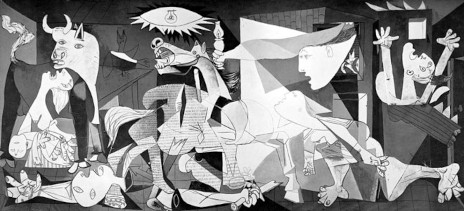
Within weeks of this event, Picasso was already working on the huge 11'x23' canvas in black and white paint only....for war drained life and color from the world. The style was neither cubist nor surreal, but Picasso's personal style with cartoon-ish, primitive, stylized figures. The scene seem to take place in something like a cellar, a place where people are fleeing from the horrors of war, horrors seen in every twisted human figure in the painting. To me, one of the most telling bit of symbolism is the electric in the upper center left. The electric eye is a symbol of progress yet it's light is impotent and the scene must be lit by an old fashioned flame just to the right.
Even today the strong symbolism of Guernica is something feared by those who would engage in war. In 2003, a copy of Guernica hanging in the United Nations was covered up and hidden so that Gen. Colin Powell and John Negroponte could speak about why war with Iraq was necessary without any pesky reminders of the cost.
Well, I hope you enjoyed learning about Picasso's Guernica, and please let me know if you have any more questions about the piece. Next week will be another Double Feature.
First of all, before Guernica was a painting, it was a town - a town in Spain where a terrible atrocity took place. During the Spanish Civil War, Spanish nationalists, lead by the famous Gen. Franco, arranged to allow German Nazis the chance to test their new bombs - on Spanish civilians. As many as 1500 people were killed and many more injured, and all of this many months before the official start of WWII.
Within weeks of this event, Picasso was already working on the huge 11'x23' canvas in black and white paint only....for war drained life and color from the world. The style was neither cubist nor surreal, but Picasso's personal style with cartoon-ish, primitive, stylized figures. The scene seem to take place in something like a cellar, a place where people are fleeing from the horrors of war, horrors seen in every twisted human figure in the painting. To me, one of the most telling bit of symbolism is the electric in the upper center left. The electric eye is a symbol of progress yet it's light is impotent and the scene must be lit by an old fashioned flame just to the right.
Even today the strong symbolism of Guernica is something feared by those who would engage in war. In 2003, a copy of Guernica hanging in the United Nations was covered up and hidden so that Gen. Colin Powell and John Negroponte could speak about why war with Iraq was necessary without any pesky reminders of the cost.
Well, I hope you enjoyed learning about Picasso's Guernica, and please let me know if you have any more questions about the piece. Next week will be another Double Feature.


 In order to put up a strong front, Justinian utilized church imagery to reinforce his political position. As this mosaic shows, Justinian styled himself a representative of God. His purple robes and halo show his majesty and position as pontif-in-chief; his prominent position in the composition let's everyone know who is in charge.
 Posts
Posts

