A little bit of mystery

Monday, June 2, 2008


Mary Lundberg is an artist hailing from Des Moins, IA. She works in a surrealist manner which may or may not be directly influenced by her previous experience in the world of corporate america.
After getting to know more about Mary, I have decided that it is not in the spirit of here work to offer analysis and easy solutions. In her words, "it is because we feel a need to understand everything that I feel the need to not explain anything." So I present you with the above work, unadorned with words.
Next week we'll have either another indie artist or a new piece of art from yours truly.

So what is a monotype, anyway?

Monday, May 26, 2008


I know the term 'monotype' confuses an awful lot of people...so what is it?

To be a bit blunt, monotype are a sort of primitive print. The artist paints his or her design directly onto a non-porous surface such as glass and then lifts the design off with some paper. (See the image on the below.)Generally, this means you can get only a few copies from one painting, so monotype editions are extremely limited.


It can be very difficult to paint detailed images this way, so monotypes work best for abstract or impressionistic imagery. The effect can even be like that of a woodblock print and the imperfections that arise from the process are part of the medium's charm.


I hope this answers some of your questions about monotypes, and we'll deal with the subject more in the future.

Broken Brown Bottles

Sunday, May 18, 2008

Well, there was a bit of drama with my isp this week so I couldn't post this article at my normal time, but I decided this would be a good opportunity to change my usual posting day to Sundays.

Today we will be looking at a piece called Broken Brown Bottles by Shera Simon (aka belltower on Etsy.)

Simon is the daughter of an artist and a pastor. As an African-American woman who grew up in the south and now lives in Philadelphia, cultural differences between states, regions, and continents have been a major influence on her art.

Broken Brown Bottles is a mixed media collage using paper, broken bottles and other found materials to express the ambivalent emotions that many African Americans are faced with when thinking of Africa. The continent of Africa is reconstructed from maps of American States, symbolically reforming the U.S. into something like that fabled, ancestral home that many children of immigrants long for, in whatever form. The bits of broken brown beer bottles invoke the wound of separation and sometime resentment that has come to exist between American blacks and native Africans. These wounds are often inexplicable, irreversible, and inexpressible.

Using the form of a map in itself highlights the artificial connections and boundaries that humans spend their lives creating and generations maintaining. Simon has managed to capture and express so much human nature without presenting a single human figure. I look forward to seeing more of this artist :)

Tune in next week to learn more about another indie artist!
Tiffany Teske Through the Looking Glass

Tuesday, May 6, 2008

TIffany Teske's love affair with photography started early. By age 7 she was already taking her own photos, and in high school she haunted her schools darkrooms. Though she has taken a few side trips away from photography, Teske has grown into her style almost to the point of creating her own world in her photos.
Ferntebrae (above) shows the overlapping worlds of Man and Nature in an almost dreamlike moment of unexpected convergence. Time slows down to a gentle ripple and slow realization dawns. How alike we are. How connected.
Yet the differences too remain and are acknowledged, not rejected.
This dreamlike atmosphere is achieved through Teske's skill and technique. Teske's method involves removing the protective layer from a polaroid photo and printing it onto a new surface. This brings out a sort of mistiness and allows some migration of the colors for interesting effects. This can be seen in all of Teske's polaroid prints. Each is unique and seems to transform the world in some subtle, fundamental way.

Thanks for reading and stop back in next week for another artist feature.

Tuesday Double Feature: Delicacy and Ink Flow

Tuesday, April 29, 2008


Hi, and welcome back for another Tuesday double feature! This week we'll take a look at work from indie artists you can find on Etsy: Carol Bruno and the dynamic duo, Michael Ayers and Lani Mathis.
Carol Bruno is a New Jersey artist whose work came into focus after the loss of her only brother. Her watercolor depiction of hydrangeas has an undeniable fragility, and the delicate colors transport one to one of those rain washed days in late spring or early summer. This is a perfect piece for contemplative viewing.
The collaborative ink creations of Ayers and Mathis, lifelong creative people, bring a different sort of energy to the table. Their many inkblot collabs, such as Seamore (above) have a wonderful sense of play that will surely brighten your day.
Both Bruno and the Ayers-Mathis team created these pieces with surrealist techniques. Bruno used a crumpling method of composition reminiscent of frotage. Ayers and Mathis created their ink blot with a method similar to the 'exquisite corpse' method in which each participant takes turns adding elements to the composition. In both cases we see how fortuitous these 'accidental' methods can be.
Next week we'll look at another indie artist, Tiffany Teske.
To find out more about Ayers & Mathis, follow the link to their blog, Green Space goods, on the right. See more of Carol Bruno's work by following the link to her shop above.

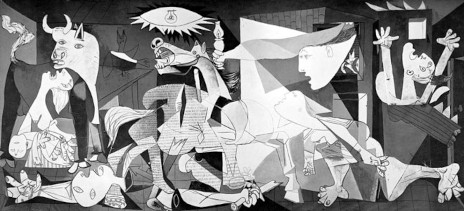
Everything you wanted to know about Guernica but were afraid to ask in less than 5 paragraphs!

Tuesday, April 22, 2008


Picasso's Guernica is like the fabled 'great American novel', oft talked of but rarely seen. It is one of those pieces of art that is so important, everyone in-the-know automatically assumes you know all about it. I hate to break it to all those art historians and critics, but Dali is actually more popular ^^ So I am going to give you all the rundown on what this Guernica stuff is all about and why it's so important.
First of all, before Guernica was a painting, it was a town - a town in Spain where a terrible atrocity took place. During the Spanish Civil War, Spanish nationalists, lead by the famous Gen. Franco, arranged to allow German Nazis the chance to test their new bombs - on Spanish civilians. As many as 1500 people were killed and many more injured, and all of this many months before the official start of WWII.
Within weeks of this event, Picasso was already working on the huge 11'x23' canvas in black and white paint only....for war drained life and color from the world. The style was neither cubist nor surreal, but Picasso's personal style with cartoon-ish, primitive, stylized figures. The scene seem to take place in something like a cellar, a place where people are fleeing from the horrors of war, horrors seen in every twisted human figure in the painting. To me, one of the most telling bit of symbolism is the electric in the upper center left. The electric eye is a symbol of progress yet it's light is impotent and the scene must be lit by an old fashioned flame just to the right.
Even today the strong symbolism of Guernica is something feared by those who would engage in war. In 2003, a copy of Guernica hanging in the United Nations was covered up and hidden so that Gen. Colin Powell and John Negroponte could speak about why war with Iraq was necessary without any pesky reminders of the cost.
Well, I hope you enjoyed learning about Picasso's Guernica, and please let me know if you have any more questions about the piece. Next week will be another Double Feature.

Tuesday Double Feature! Mystery and Whimsy

Monday, April 14, 2008


Madelaine and Lance Perry bring a lot of creativity to the table when they get to work. (Above left 'how i got my stutter' Madelaine; above right 'Ladybug with a Flower' Lance Perry.) Madelaine brings us the insecurities and dilemmas of growing up while Perry takes us back to the childhood we never knew.

Madelaine, a Canadian born artist living in West Virginia, is a precocious 17 already in college and supporting herself through her art (you go, girl!) 'How i got my stutter' is a piece of digital art laden with imagery culled from childhood vulnerability, tea lore, and criminal psychology.

Using her own features, Madelaine created a waif of a girl, thin beyond belief. Holding a butterfly suspended like a tea bag, we are reminded of some of the more dreadful childhood passtimes: pulling the wings off flies, burning ants with magnifying glasses. The way the young woman holds the butterfly, however, tells us that the movement has been arrested. Whatever personal pain might have prompted her to think of making butterfly tea, that pause shows that she can regain her purity, if not innocence, but we are not allowed to see the final outcome. Will she make it to a better place or enjoy a nice cup of butterfly tea?

Madelaine herself says of the piece, "As for the part of my personality it reflects... that would be my extreme desire to be what she is (the girl in the image). It reflects my desire to be a pure (I don't mean sexless, I mean free of anger and lies), honest, and good person. I wouldn't ever wish to rid myself of sadness or any other negative emotion, as without sadness, I would never be happy, but there are things in my life or around me that I do wish to be rid of."

In "Ladybug with Flower" Perry, a Texas artist, takes us back to childhood, one populated with nursery rhyme characters and figures from the American subconscious.

Perry says of his work, "There's a part of me inside that never grew up. This part of me has and will always be fascinated by the colorful characters of nursery rhymes, children's stories and movies. I guess this is because there are no boundaries in the world of folklore, and I would like to be a part of that in what way I can. In this piece, how cool would it be if little bugs and critters could carry on such lives as this. In the world of folk art, it is possible. This little guy is stemmed with artistic influence from Tim Burton and other artists from children's stories. The part of my personality that this piece reflects is the joyful, curious child inside. When creating this piece it put a smile on my face, and I hope that it can do the same for my audience.

These two artists take us back to childhood themes, not with nostalgia, but with curiosity and an explorer's ethic. Please take a look at their work on Etsy and join me again next week when I take a look at Picasso's Guernica.

Visit me on Etsy

 
ZephiArt. Design by Pocket